Summary of The Third Level
“The Third Level” is a story about Charley, a 31-year-old man living in modern New York, who believes he has discovered a mysterious third level at Grand Central Station. Officially, the station has only two levels, and both the authorities and his psychiatrist friend insist that Charley is imagining things because he is stressed by the insecurities of modern life—war, fear, and worry. According to the psychiatrist, Charley is simply longing for escape.
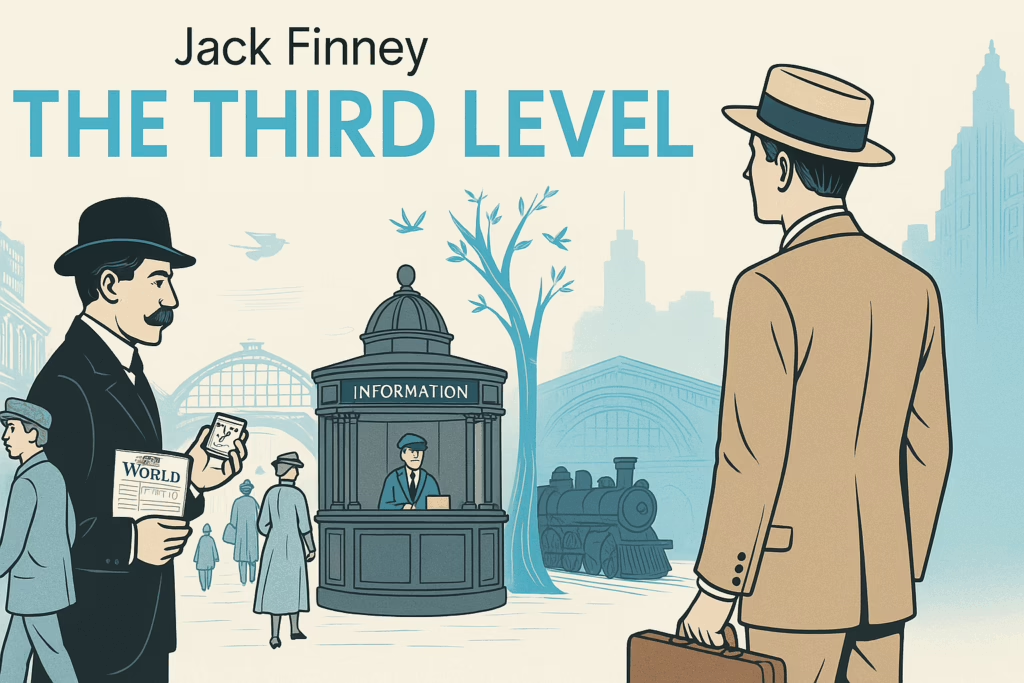
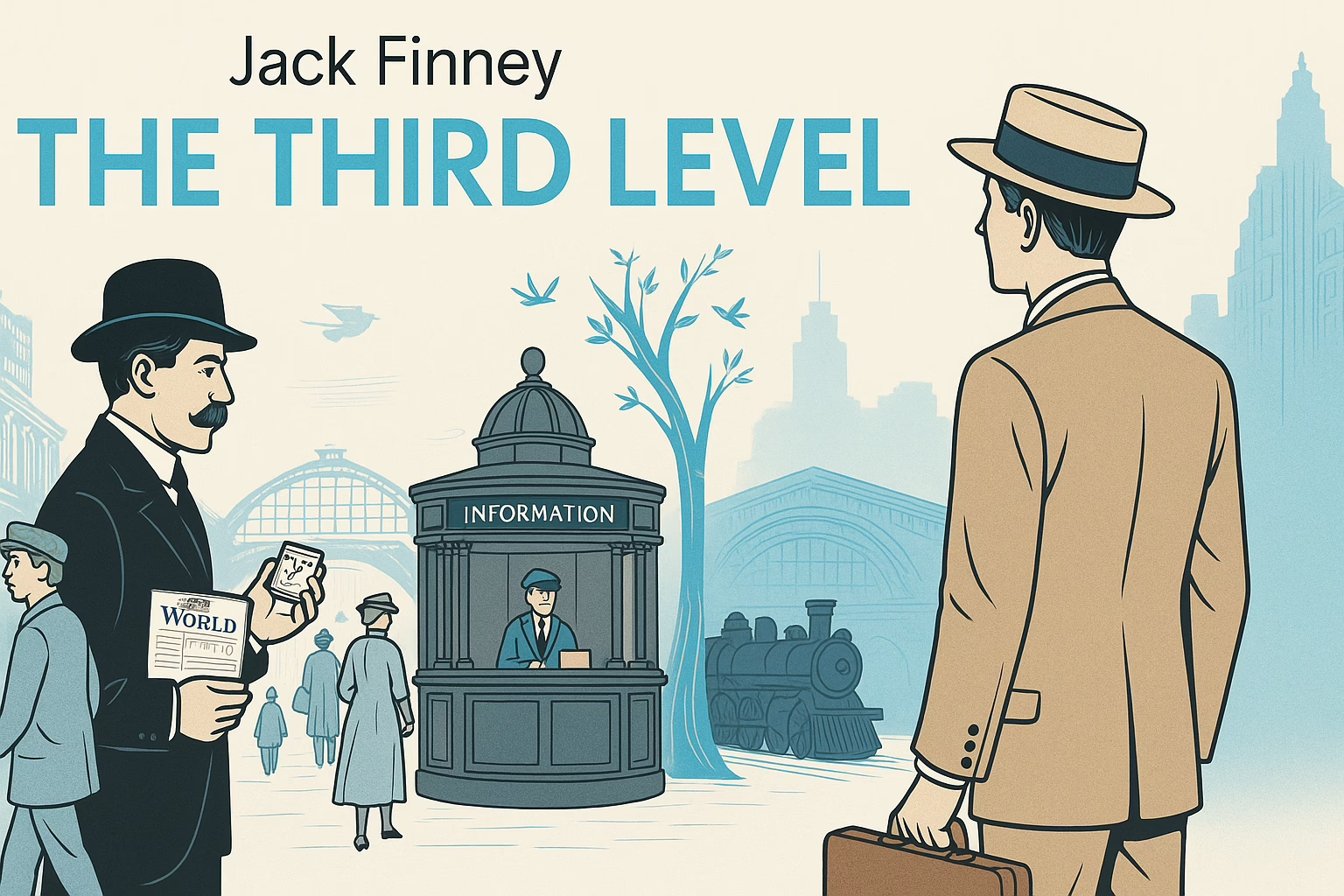
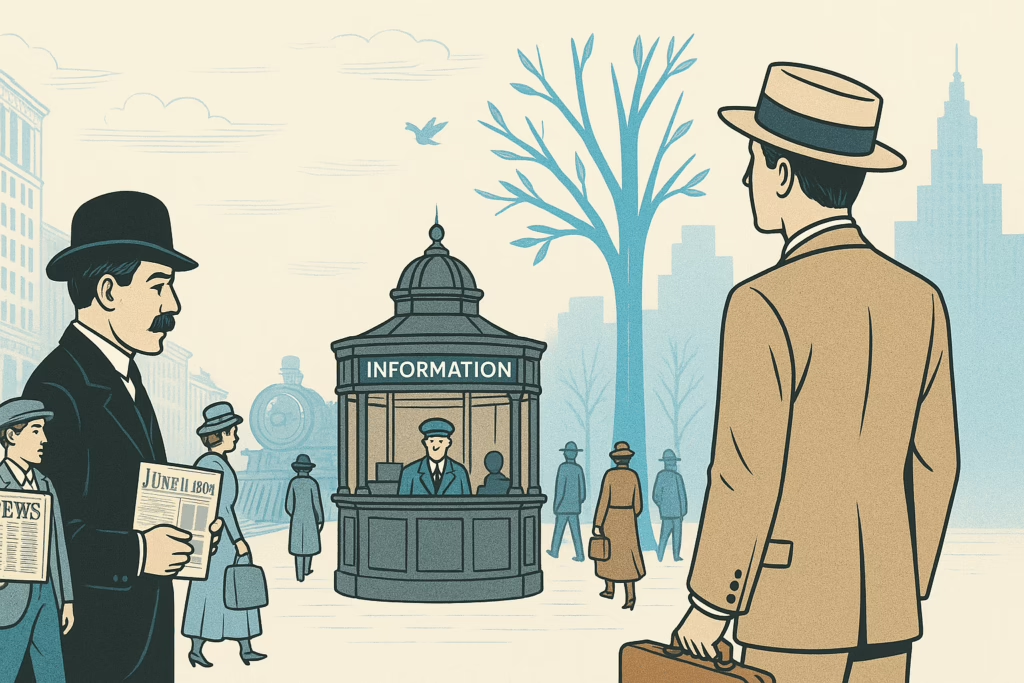
One evening, while returning home, Charley accidentally wanders through unfamiliar corridors in Grand Central and finds himself in a strange old-fashioned station lit by gaslights, with people dressed in 1890s clothing. The newspaper on sale is The World, dated June 11, 1894. Realizing he has somehow reached the past, Charley tries to buy two tickets to Galesburg, Illinois, an ideal, peaceful town from his childhood memories. But his modern money exposes him, and he flees before being suspected of cheating.
Determined to return, Charley withdraws all his savings to buy old-style currency, hoping to use it on the third level. However, he never finds the corridor again. His wife Louisa becomes worried and makes him stop searching—until something unexpected happens.
One night, while looking through his stamp collection, Charley finds an old first-day cover that should not have been there. Inside is a letter dated July 18, 1894, written by his psychiatrist friend Sam. In it, Sam confirms that the third level is real and that he himself has reached Galesburg, where he is now living happily. Charley later learns that Sam bought $800 in old currency—enough to start a new business in 1894.
The revelation that Sam has vanished into the past renews Charley’s hope. The story ends with Charley and Louisa searching for the third level every weekend, believing that escape to a calmer, more peaceful world may still be possible.
About the Author — Jack Finney
Walter Braden “Jack” Finney (1911–1995) was an American novelist and short-story writer best known for his works that blend fantasy, science fiction, time travel, and everyday realism. Born in Milwaukee, he later moved to California, where he spent most of his life writing stories that fascinated readers with their imaginative yet believable worlds.
Finney’s writing is marked by a gentle, nostalgic tone and an interest in the contrast between the modern, stressful world and the peaceful simplicity of the past. This theme appears strongly in The Third Level, where a troubled modern man escapes into the 1890s.
He gained widespread fame for his novels:
- “The Body Snatchers” (1955) — which inspired several films titled Invasion of the Body Snatchers.
- “Time and Again” (1970) — a classic time-travel novel celebrated for its rich historical detail.
Jack Finney’s works continue to be admired for their ability to mix fantasy with psychological depth, showing how humans often long for a more secure, idealized past.
Textual Questions and Answers
Read and Find Out — Answers
1. What does the third level refer to?
The third level refers to a mysterious, imaginary, or possibly supernatural level at the Grand Central Station that Charley claims to have discovered.
Although officially the station has only two levels, Charley insists he reached a third one, which transported him into the year 1894, complete with:
- open-flame gaslights
- old-fashioned wooden ticket booths
- people dressed in 1890s clothing
- old-style newspapers like The World mentioning President Cleveland
(Page 3–4)
Thus, the third level represents an escape into a calmer, earlier time.
2. Would Charley ever go back to the ticket counter on the third level to buy tickets to Galesburg for himself and his wife?
The text suggests that Charley hopes to return but has never succeeded:
- He and Louisa searched repeatedly but “I’ve never again found the corridor that leads to the third level” (page 5).
- He initially stopped looking, but after discovering Sam’s letter, “now we’re both looking every weekend” (page 5).
So the answer is:
Charley wants to go back and keeps searching, but there is no confirmation that he ever finds the third level again. The story ends with hope, not certainty.
Reading with Insight — Answers
1. Do you think that the third level was a medium of escape for Charley? Why?
Yes, the third level was a medium of escape for Charley.
His psychiatrist explicitly suggests that Charley is “unhappy” and that the modern world is full of insecurity, fear, war, worry and all the rest of it (page 1). Charley himself admits that everybody wants to escape, and his longing for the peaceful world of 1894—where evenings were long, people relaxed on lawns, and life felt secure (page 4)—shows that this imagined third level gives him psychological relief from modern anxieties.
Thus, it represents his desire to retreat into a safer, idealized past.
2. What do you infer from Sam’s letter to Charley?
Sam’s letter proves two things:
a) Sam also found the third level.
He writes directly from Galesburg, Illinois, dated July 18, 1894, describing a peaceful, pleasant life—people singing on porches, playing piano, and inviting him for lemonade (page 6).
b) It validates Charley’s belief.
Sam admits: “I got to wishing that you were right. Then I got to believing you were right. And, Charley, it’s true; I found the third level!” — confirming that Charley’s experience was not just fantasy.
c) Sam used old currency to start a new life.
Charley learns that Sam bought $800 worth of old-style currency, enough to start a business in 1894 (page 6).
Ironically, Sam himself is Charley’s psychiatrist—the same person who initially dismissed Charley’s claim.
3. ‘The modern world is full of insecurity, fear, war, worry and stress.’ What are the ways in which we attempt to overcome them?
People cope with stress and insecurity through several methods, such as:
- Hobbies (e.g., Charley’s stamp collecting, which his psychiatrist calls “temporary refuge from reality”—page 1)
- Traveling or imagining more peaceful places
- Seeking therapy or counselling
- Meditation, exercise, leisure activities
- Escapist fantasies (as seen in Charley’s dreamlike discovery of a calmer past)
Humans naturally try to find comfort when life feels overwhelming.
4. Do you see an intersection of time and space in the story?
Yes.
The entire story is based on a fantastical intersection between 20th-century New York and the world of 1894:
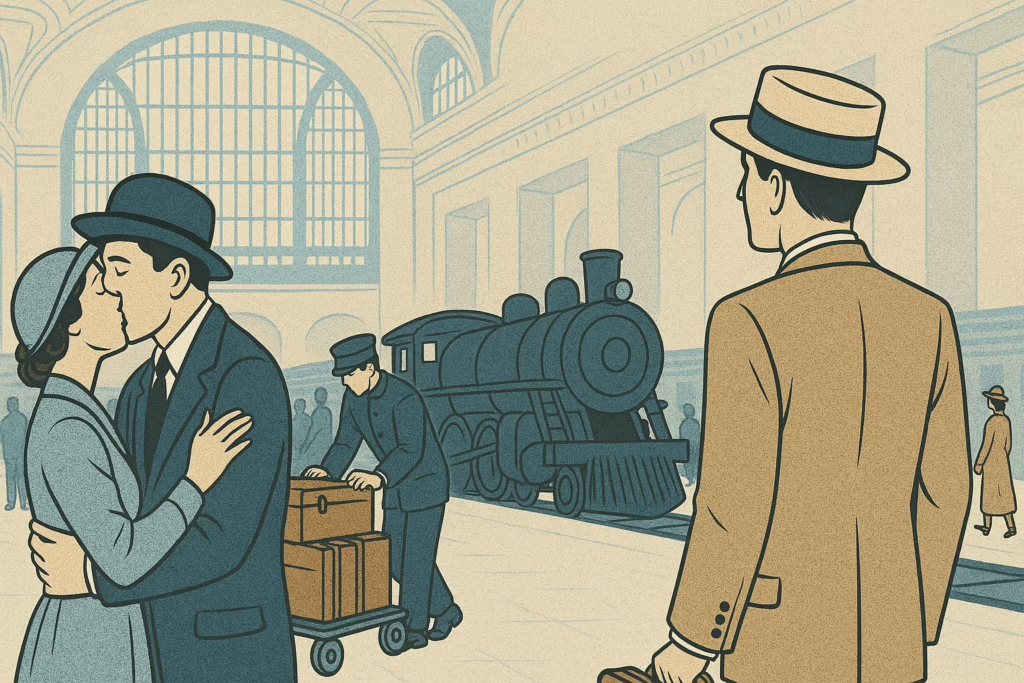
- Charley moves physically through the modern Grand Central Station, but suddenly steps into a version of it from 1894—with gaslights, old clothing styles, brass spittoons, an old locomotive, and newspapers mentioning President Cleveland (pages 3–4).
- Sam’s letter, dated 1894, appears inside Charley’s modern stamp collection (page 6), merging two timelines.
This intersection creates a blend of reality and fantasy where time flows unpredictably.
5. Apparent illogicality sometimes turns out to be a futuristic projection. Discuss.
The story’s illogical events—like the third level, a corridor existing to 1894, or a psychiatrist ending up in the past—seem impossible.
However, such imaginative leaps often inspire future possibilities:
- Science fiction has predicted technologies like virtual reality, time travel concepts, and alternate realities.
- The idea of escaping into another time resembles future ideas of time–space manipulation, parallel worlds, or psychological time travel.
Finney’s narrative shows that what seems illogical today may reflect future theories or advanced psychological understandings.
6. Philately helps keep the past alive. Discuss other ways this is done. What do you think of the human tendency to constantly move between the past, the present and the future?
How we keep the past alive:
- Museums, archives, libraries
- Preservation of historical sites
- Photography, journaling, recorded history
- Literature, folk songs, documentaries
- Family traditions and oral history
In the story, stamp collecting preserves old stamps, currency and dates, allowing Charley to find Sam’s letter from 1894 (page 5–6).
Human tendency to shift between time frames:
People naturally:
- Recall the past for comfort or lessons
- Live in the present but often feel stressed
- Dream of the future for hope or escape
This continuous movement keeps us emotionally balanced but also fuels imagination and fantasy.
7. Compare the interweaving of fantasy and reality in The Third Level and Adventure by Jayant Narlikar.
In The Third Level:
- Fantasy: A magical third level that leads to 1894.
- Reality: Modern New York, Grand Central Station, stamp collecting, psychological stress.
- Blend: Charley moves from the real world into a mysterious time slip. Sam’s letter bridges both worlds.
In Adventure:
- Fantasy: Professor Gaitonde experiences a parallel world where Indian history has taken a different turn.
- Reality: Modern scientific theories like the Catastrophe Theory and quantum physics that explain alternate realities.
- Blend: Gaitonde’s journey is treated as a scientific possibility as well as a personal experience.
Common theme:
- Both stories blur fantasy and reality in ways that feel believable.
- Both protagonists experience alternate timelines and return with proof.
Difference:
- The Third Level uses psychological escape as its core.
- Adventure uses scientific reasoning for alternate history.
Conclusion
The Third Level by Jack Finney remains a remarkable blend of fantasy and psychological insight, inviting students to reflect on the pressures of the modern world and the enduring human desire to escape into a simpler past. The questions explored in this article—ranging from understanding Charley’s motivations to examining themes of time, reality, memory, and imagination—help learners engage deeply with the text and its broader implications. By analyzing the story’s intersections of fact and fantasy, students sharpen their critical thinking and appreciate how literature mirrors human anxieties, hopes, and dreams. Ultimately, these questions encourage a richer reading experience and prepare Class XII learners to approach literature with curiosity, sensitivity, and a thoughtful, analytical mind.