SUMMARY — Journey to the End of the Earth
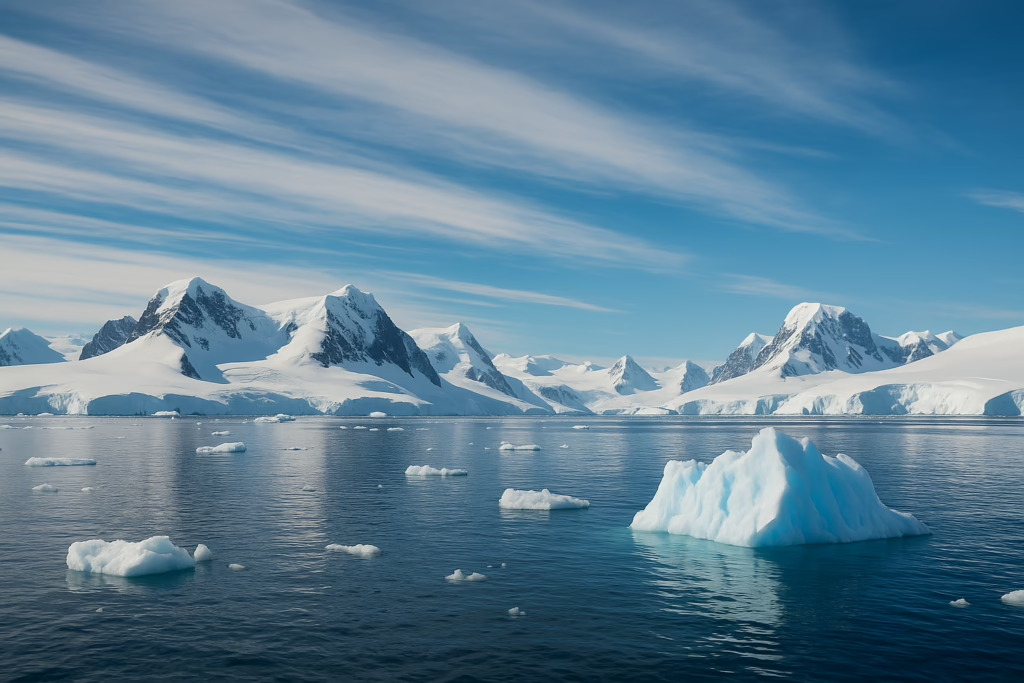
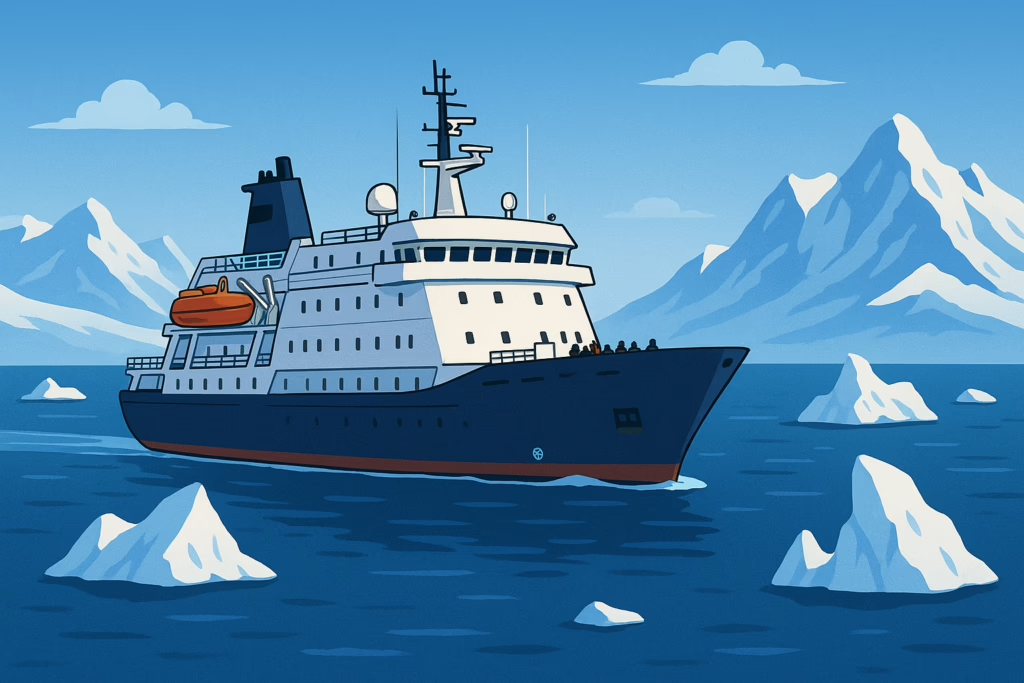
Tishani Doshi describes her extraordinary journey to Antarctica aboard the Russian research ship Akademik Shokalskiy. Travelling across nine time zones and multiple seas, she finally reaches the coldest, driest, and windiest continent on Earth. Her first reaction is one of relief, followed by deep wonder at the vast white landscape and the realisation that India and Antarctica were once connected as part of the ancient supercontinent Gondwana.
The author explains how studying Antarctica helps us understand Earth’s geological past, including continental drift, climate shifts, and evolutionary changes. With 90% of the planet’s ice stored here, Antarctica becomes a natural laboratory revealing the effects of global warming. Glaciers retreating, collapsing ice shelves, and carbon records trapped in ice layers highlight the urgent environmental dangers created by human activity.
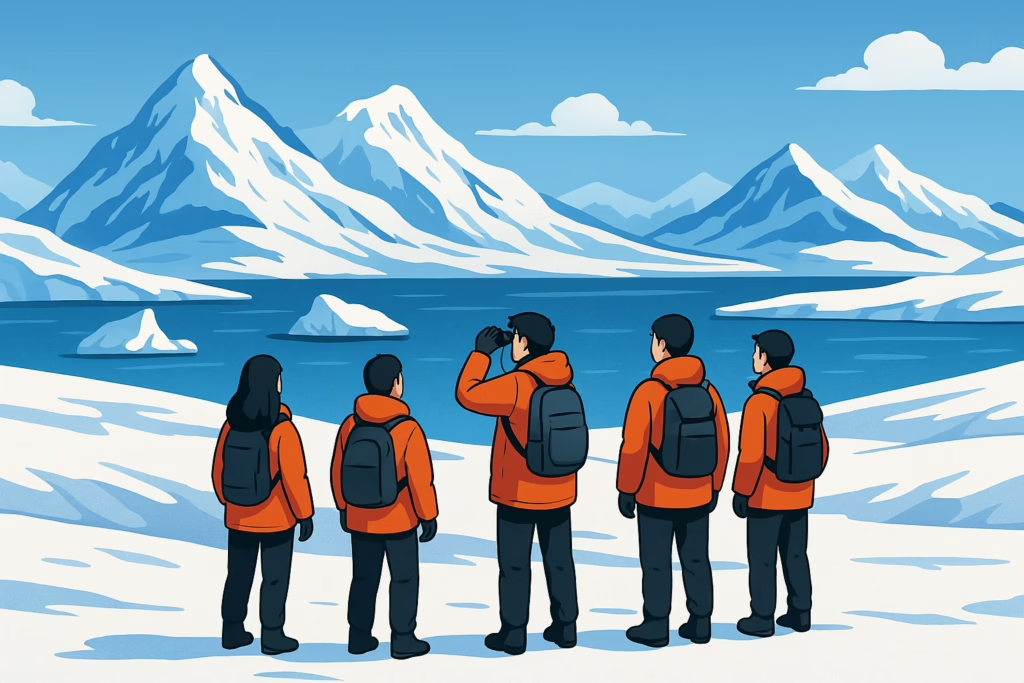
She also describes her participation in the Students on Ice programme, which brings young students to Antarctica to inspire environmental awareness. The simple and fragile ecosystem of Antarctica shows how even tiny organisms like phytoplankton play a crucial role in sustaining the entire food chain. Any damage to them—caused by ozone depletion or global warming—can disrupt life across the planet.
One of her most powerful experiences occurs when she walks on the frozen ocean, standing on a metre-thick ice sheet with hundreds of metres of seawater below. This moment reveals an essential truth: everything on Earth is interconnected, and the planet’s balance is delicate.
The chapter concludes by reminding readers that although Earth’s geological changes occur over millions of years, human actions in just a few thousand years have placed the planet in danger. Yet, seeing the enthusiasm of young students gives the author hope that the future can still be protected.
About the Author — Tishani Doshi
Tishani Doshi (born 1975) is an acclaimed Indian poet, novelist, and journalist known for her deep engagement with themes of identity, environment, and human experience. She was born in Chennai, Tamil Nadu, and studied in both India and the United States. Apart from being a writer, she is also a dancer who has performed with the renowned choreographer Chandralekha.
Doshi has published several collections of poetry and fiction, earning international recognition, including the Forward Poetry Prize for Best First Collection. Her writing is known for its lyrical beauty, emotional depth, and strong environmental concerns.
In Journey to the End of the Earth, she combines travel writing with ecological awareness, using her Antarctic journey to highlight the importance of protecting our planet.
READ AND FIND OUT – Answers
1. How do geological phenomena help us to know about the history of humankind?
Geological phenomena—such as the movement of continents, formation of mountains, folding of rocks, and the creation of ice cores—help us understand how the earth has changed over millions of years.
From studying them, we learn:
- How continents like India and Antarctica were once part of the same supercontinent (Gondwana).
- How climatic and biological histories evolved.
- How the earth’s surface was shaped and how life forms developed or went extinct.
Thus, geology reveals the deep past of both earth and humankind.
2. What are the indications for the future of humankind?
The text suggests an alarming prognosis for humankind:
- Human activity has caused excessive carbon emissions.
- The global temperature is rising.
- Ice sheets are melting, ice shelves collapsing, and glaciers retreating.
- If climate change continues unchecked, the earth may face severe consequences—possibly threatening human survival.
Therefore, the future of humankind is uncertain and potentially dangerous.
READING WITH INSIGHT – Answers
1. ‘The world’s geological history is trapped in Antarctica.’ How is the study of this region useful to us?
Antarctica contains:
- Half-million-year-old carbon records preserved in its ice cores.
- Evidence of continental drift (like the separation of Gondwana).
- Indicators of climate change, evolution, and extinction.
Studying Antarctica helps scientists:
- Understand past climates and predict future climatic patterns.
- Examine changes in carbon levels across millennia.
- Assess the impact of global warming.
Thus, Antarctica works like a time capsule of Earth’s geological history.
2. What are Geoff Green’s reasons for including high school students in the Students on Ice expedition?
Geoff Green believes:
- Young people are at the perfect age to absorb knowledge.
- They are the future policymakers and caretakers of the planet.
- Seeing Antarctica firsthand leaves a deep emotional impact that inspires long-term environmental responsibility.
He wants youth to gain “a life-changing experience” so they can act meaningfully for the planet.
3. ‘Take care of the small things and the big things will take care of themselves.’ What is the relevance of this statement in the context of the Antarctic environment?
In Antarctica, even tiny changes—like the effect of ozone depletion on microscopic phytoplankton—lead to large consequences:
- Phytoplankton sustain the entire marine food chain.
- If they are harmed, seals, whales, birds, and the global carbon cycle will suffer.
Thus, protecting small organisms and small environmental components is essential to maintaining Earth’s balance.
The message: Small actions matter.
4. Why is Antarctica the place to go to, to understand the earth’s present, past and future?
Antarctica is the ideal place because:
- It has never supported a human population → remains pristine.
- Its ice holds ancient climate data that reveal earth’s geological history.
- The continent clearly shows the effects of global warming (melting ice, collapsing shelves).
- Its simple ecosystem makes environmental changes easy to observe.
- The interaction between climate, organisms, and ecosystems is clearly visible.
Hence, Antarctica is the best laboratory for understanding Earth’s evolution, current climate crisis, and future possibilities.
ADDITIONAL QUESTIONS FOUND WITHIN THE TEXT
Q: What was the author’s first emotion on seeing Antarctica?
Relief, followed by profound wonder at the immensity, isolation, and history of the continent.
Q: Why does Antarctica feel like a ‘giant ping-pong ball’?
Because it has:
- No human markers
- No trees, buildings, or billboards
- Endless white landscape and blue horizon
This makes it feel featureless, vast, and surreal.
Q: Why is climate change such a critical issue related to Antarctica?
Because Antarctica:
- Stores 90% of the earth’s ice.
- Reflects global temperature rise through melting trends.
- Contains carbon records essential for climate prediction.
Any disturbance here affects the whole planet.
Q: Why does the author call her walk on the ocean a revelation?
Walking on meter-thick ice over 180 meters of ocean made her realize:
- How intimately everything on Earth is connected.
- How delicate and interdependent the natural balance is.
It was a powerful, transformative moment.